
If you feel drawn to the moon, learning about lunar deities can give you another way to explore that connection. Their stories bring together themes such as love, change, independence and finding your way through uncertain moments, although each deity belongs to a particular tradition and has a story beyond the moon.
I like beginning with those stories before thinking about rituals or offerings because knowing a deity’s name and a few symbols doesn’t always tell us much about them.
You can read, reflect and stay curious without feeling that you need to begin working with anyone straight away. Here are five familiar names to explore, with simple ideas for bringing what you learn into your own practice and life!
What is a lunar deity?
A lunar deity is a god or goddess connected with the moon, but that connection can take different forms. Some represent the moon itself while others became associated with it alongside their wider roles in religion and mythology.
Lunar deities aren’t always female either, so there is no single idea of “moon energy” that explains every tradition. For me, that makes learning about them more interesting, especially when we allow their differences to remain part of the picture.
Selene
If you want to begin with a deity whose connection is directly lunar, Selene is a clear starting point. In Greek mythology, she personifies the moon and travels across the night sky in a chariot, while her siblings Helios and Eos are associated with the sun and dawn. One of her best-known stories concerns her love for the mortal Endymion, who rests in an everlasting sleep in familiar versions of the myth.

Selene visits him at night, making their story closely connected with moonlight, longing and a love separated from ordinary waking life. Details vary between tellings, so it is worth exploring more than one version.
What catches my attention is the feeling of time moving differently at night, when everything becomes quieter and thoughts have more room. As a personal reflection inspired by Selene, you could spend a few minutes looking at the moon and write about something you want to understand more gently, without demanding an answer immediately.
Artemis
She is my favourite one! Artemis is widely known as a Greek goddess of the hunt and wild places, often shown carrying a bow with a deer nearby.
Her moon association developed alongside connections with other goddesses, so it helps to remember that she has a much wider identity than “moon goddess.”

She is the daughter of Zeus and Leto and the twin sister of Apollo. One story says that after her own birth, Artemis helped her mother deliver Apollo, connecting her fierce independence with a protective role around childbirth.
For me, this offers an interesting point of reflection: caring for others doesn’t have to mean giving up your own space. If that theme speaks to you, begin by learning more about her stories and perhaps journal about a boundary you want to respect rather than immediately preparing a complicated ritual.
Hecate
Hecate is familiar to many witches through her connections with magick, crossroads and the darker part of the lunar cycle. Her symbols include torches and keys, although her history reaches beyond the modern image of a mysterious goddess standing beneath a dark moon.
In the story of Persephone, Hecate helps Demeter search for her missing daughter, carrying torches through the darkness. She also becomes a companion to Persephone, giving her a role connected with guidance and movement between worlds.
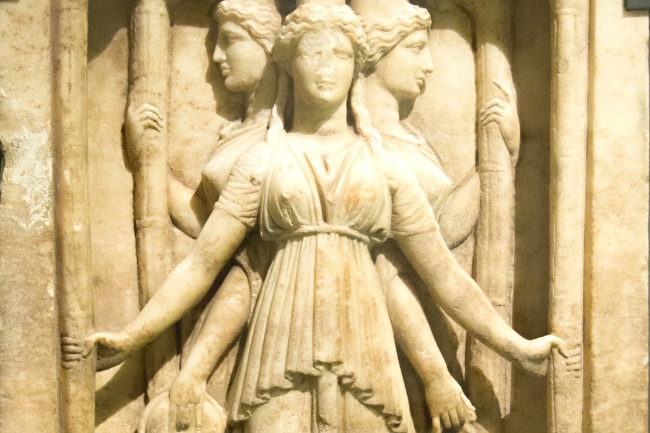
I find the image of carrying a light through uncertainty especially meaningful, because you don’t always need to see the whole path to consider your next step. A personal practice inspired by that image could be writing down a decision you face and separating what you know from what you still need to learn.
If you want to explore her lunar worship more specifically, our guide to Hecate’s supper introduces the Deipnon, observed at the end of the lunar month.
Thoth
Thoth reminds us that lunar deities aren’t all goddesses. In ancient Egyptian religion, he is associated with writing, wisdom and the measurement of time, with the moon forming part of that connection.
Often represented with an ibis head or as a baboon, Thoth belongs to stories and religious traditions where knowledge, records and the ordering of the world are important. His lunar role makes sense alongside timekeeping, since the changing moon provides a visible cycle to observe.
Rather than approaching him only through the idea of increasing psychic ability, I would begin with learning and careful observation. You could keep a simple moon journal and record the phase alongside something you learned that day, treating this as your own reflective activity rather than claiming it is an ancient Egyptian ritual.
Chang’e
Chang’e is a well-known figure in Chinese moon traditions, especially around the Mid-Autumn Festival. Her story has several versions, which is part of what makes it worth reading with care. In one familiar telling, her husband Hou Yi saves the world by shooting down nine of ten scorching suns and receives an elixir of immortality.
When someone tries to take it, Chang’e drinks it herself and rises to the moon, becoming separated from her husband. There is something very human in a story about love and distance, even though its setting is extraordinary.
You might reflect on someone you miss or make time to reconnect with a loved one, while remembering that Chang’e belongs to Chinese cultural and religious traditions rather than treating her as another name for a Greek moon goddess.
How do you choose which deity to learn about?
Start with curiosity rather than trying to identify who is “calling” you from a single dream or repeated image as a story stays with you or a deity’s wider role makes you want to read more, and that is enough reason to begin.
I would choose one name and spend time with their stories before buying statues or preparing offerings.
Notice what interests you and what you don’t yet understand, then let those questions guide your learning.
Do you need to work with a deity to practice moon magick?
No! You can observe the moon, keep a journal or create personal lunar rituals without including deity worship. Learning about these deities can still enrich your understanding, even if you never feel a devotional connection.
For me, respect includes being able to appreciate someone else’s practice without feeling that I must make it my own.
Getting started in a simple way
Choose one story from this list and read the fuller guide, then write down what happened before adding your own interpretation. Keeping those two things separate helps you notice the difference between the myth and what it personally brings up for you.
Afterward, choose one gentle question to explore, such as “Where do I need more independence?” or “What would help me take my next step?” You don’t need a sign or an unusual experience to make the time worthwhile.
Conclusion
Lunar deities offer different ways to understand the moon through story, religion and personal reflection, with each figure bringing much more than a list of symbols.
Take your time with the names that interest you and learn about the traditions they belong to. You can begin with a story, a notebook and a little curiosity, allowing any deeper connection to develop at its own pace.


