
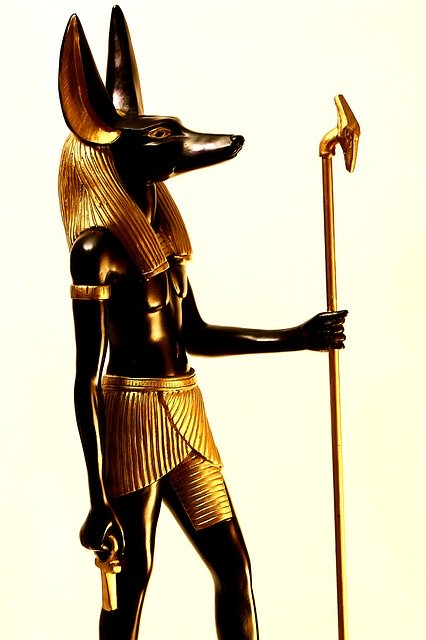
Anubis is the Egyptian God of the dead and the embalming process. He presided over the embalming of Osiris when he was killed by Seth. Priests would sometimes wear masks of Anubis when performing embalming rituals.
He is associated with the jackal and often imaged with a jackal’s head.
Who is Anubis?
Anubis is an ancient Egyptian god associated with embalming, burial and the protection of the dead. He is usually shown as a jackal-headed man or a jackal-like animal. His recognizable appearance reflects his place in Egyptian funerary beliefs.
In Egyptian mythology, he also helped prepare the body of Osiris after his death. This connection is one reason care for the deceased is such an important part of understanding him.
I would keep this background in mind before looking for candles or offerings. Knowing a little about a deity helps you approach them as more than a name attached to a spell.
What does Anubis represent?
Protection of the dead is central to his role but Anubis also appears in the weighing of the heart. In this ancient Egyptian judgment scene, he watches over the scales to make sure the weighing is fair. For personal reflection, I find this a useful image. It invites questions about honesty, responsibility and how we treat others.
You might ask yourself whether your actions match the person you want to be. Connecting him with a difficult life change can also be meaningful in a modern practice. Just remember that this is a personal way of relating to his stories rather than an ancient rule for every situation.
Is Anubis evil or dangerous?
No!! And his association with death doesn’t make him evil! Looking at his protective role can help you move beyond the frightening image that sometimes appears in films or online.
That said, you don’t have to feel comfortable with every deity. If you don’t feel the connection simply let him go.
Can baby witches honor Anubis?
Yes, a beginner can start by learning about him and offering a few respectful words. You don’t need to attempt spirit contact or work with the dead to acknowledge
Anubis. I would begin with one quiet moment rather than a whole list of rituals. Read about his role, choose what you want to say and notice how you feel about continuing.
You can appreciate him without becoming a big devotee too. Learning about a deity is valuable even when it doesn’t lead to a regular practice.
How can you introduce yourself?
Choose somewhere you can sit without rushing. Clear a little space and place an image of Anubis there if you have one. A picture in a book is enough! You could say something like:
“Anubis, I come with respect and a wish to learn. May I approach your stories with care and honesty.”
Then spend a few minutes quietly thinking about why you wanted to begin. There is no need to wait for a voice, a sudden feeling or an unusual event. An introduction can simply be an introduction.
What should you put on an Anubis altar?
I would keep a beginner altar small: an image of Anubis, a black candle and a clean dish for an offering. That’s a great place to get started
What is the best candle color for Anubis?
For a simple modern practice, I would choose black candle. It connects visually with his traditional images and gives you something clear to focus on. I love that choice!
What offerings can you give Anubis?
A small dish of fresh water is an easy first offering. If you want something more personal, you could write a short dedication about protecting the vulnerable or treating the memory of the dead with care.
Do you need to honor Anubis on a certain day?
You don’t need to wait for a particular weekday to begin a simple personal practice. Choose a moment when you can give it your attention. An evening may feel comfortable because the house is quieter but darkness isn’t a requirement.
A peaceful morning is just as suitable for reading, making an offering or saying a prayer. I would rather choose a time you can enjoy than turn devotion into another deadline.
Can you honor him while grieving?
You may find comfort in reflecting on a deity whose role includes care for the dead. A quiet dedication could accompany writing down a memory or looking after a remembrance space. Keep it gentle. You don’t need to ask for contact with someone who has died or treat every dream as a message.
Remembering a person with love is meaningful on its own. If the practice leaves you feeling more upset, pause and choose something comforting instead. Your grief doesn’t need to become a spiritual task.
What if you don’t feel a connection?
That is okay! You can learn about Anubis, respect his place in Egyptian religion and decide that devotional work isn’t for you. You also don’t need to interpret repeated pictures, animals or names as proof that he is calling you. Sometimes a subject catches our attention because we have recently started noticing it. Let interest be enough while you explore.
Conclusion
Anubis is so powerful and his lore is so meaningful. If you want to honor him, begin with understanding. Read a little, prepare a small space and speak honestly without trying to create a dramatic experience.
You can take baby steps and change your approach as you learn. A respectful practice has room for questions, quiet moments and the freedom to discover if this connection feels right for you.
Learn More Online
- Check out Anubis’s entry in the Mythopedia https://mythopedia.com/egyptian-mythology/gods/anubis/
- Get an overview of the historical context of Anubis at Ancient Egypt Online https://ancientegyptonline.co.uk/anubis/
- Charlie Larson at the Agora at Patheos writes about Anubis often.
- Learn About the Anubis Oracle Card set http://theanubisoracle.com/


