
Well dressing is a tradition of decorating wells for summer celebrations. It is an ancient Celtic custom that continues in the remote regions of England, particularly Derbyshire and Staffordshire.
It may be that the remoteness of these regions helped preserve these traditions by making it difficult for invaders to reach them.
KEY TAKEAWAYS
Well dressing is an ancient tradition rooted in pagan rituals, now embraced by some modern witches as a form of nature-based spirituality.
It involves creating intricate and temporary artworks on wooden frames, adorned with flower petals, leaves, and other natural materials, which are placed atop wells or water sources.
This practice is believed to bring blessings, protection, and healing to the community, as well as to foster a deeper connection with the natural world.
Well dressing festivals are celebrated in various regions, with one of the most famous events taking place in Tissington, England, attracting thousands of visitors each year.
The Tradition
The tradition of well dressing likely began as a sacrificial act to thank the spirit of the well or perhaps a God or Gods for providing the community with water throughout the year, or perhaps to celebrate the fact that it was there.
Well dressing generally takes place in the month of June though it can take place throughout the summer into early autumn.
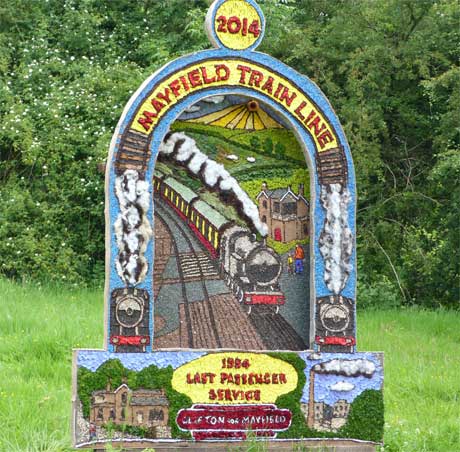
The wells are dressed with flowers and greenery in their simplest form, but in Derbyshire, the dressings can be very elaborate pictures made of flower buds, leaves, pine needles and other plant parts carefully arranged and pressed into clay to create beautiful mosaics.
Many Pagans will bring flowers to their well or another water source, reminiscent of this custom.
What are clootie wells?
Clootie Wells are wells or fountains, almost always with a tree next to them, where strips of cloth or rags are tied to the branches, in the hope of curing an illness.
Why a well?
Since ancient times, wells have had magical implications, in addition to their secular significance. The magic of wells is found primarily in Celtic mythology…it’s easy to immediately associate them with the “Grail Well” or “Chalice Weel,” the place where the Grail was said to be hidden, a place not surprisingly a symbol of the Mother Goddess’s unique religion.
Thus, in addition to collecting water, the well has a profound symbolic value: it becomes a place where purification rites can be performed. In this case, the well takes on more of the connotations of a basin. It can also be a way to connect man to the earth, hence the flourishing of bottomless wells like St. Patrick’s in the Middle Ages.
But this is not the only aspect of wells; there are numerous legends of “wishing wells,” where simply tossing a coin would grant one’s aspirations. In this last aspect, the well again resembles the fountain; a coin is tossed into the fountain to make and grant a wish.
The well, therefore, has always had a strong magical significance, and is thus closely linked to the cults of chthonic, or earthly, deities, but not only that. In fact, the well is the link between heaven and earth, an ancient symbol of the now-extinct cult of the White Goddess.
The well thus becomes a place of purification, but for the location to be suitable, the first thing to do is FIND THE MOON IN THE WELL, a popular expression that signifies the fulfillment of a wish, something truly difficult and rooted in something far more important and ancient, which we will now discuss.

Well dressing
There are some truly unique places in the United Kingdom. Here, where Celtic traditions are still deeply rooted, there are places still visited by pilgrims today, supporting a centuries-old popular belief: making offerings to “wishing trees,” wells, or fountains.
If you travel to Scotland, Ireland, or England, make sure to include a stop in your guidebook at least one of the “Clootie wells,” literally “cloth fountains.” A “Clootie” is, in fact, a well or fountain, almost always surrounded by a tree, where strips of cloth or rags are tied to the branches in the hope of healing an illness.
To make an offering, pieces of cloth or “cloot” are generally immersed in the water of the sacred well and then tied to a branch, while a prayer invokes “the spirit of good.” In some wells, the affected body part is washed with the wet cloth before being tied to the tree.
According to tradition, as the rag gradually disintegrates over time, the disease should vanish. Over the centuries, strips of clothing have also given way to socks, dresses, T-shirts, and pants, even pieces of rotten fabric. Today, the sight of one of these places is both disturbing and fascinating, perhaps leaving us skeptical of the “faith” that drove such a seemingly grotesque act.
The lore
The tradition of well dressing likely began as a sacrificial act to thank the spirit of the well or perhaps a God or Gods for providing the community with water throughout the year, or perhaps to celebrate the fact that it was there.
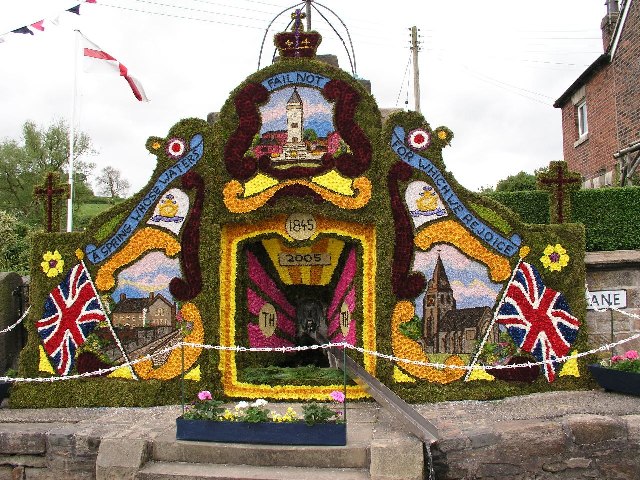
Well dressing generally takes place in the month of June though it can take place throughout the summer into early autumn. The wells are dressed with flowers and greenery in their simplest form, but in Derbyshire, the dressings can be very elaborate pictures made of flower buds, leaves, pine needles and other plant parts carefully arranged and pressed into clay to create beautiful mosaics.
Many Pagans will bring flowers to their well or another water source, reminiscent of this custom.
The origin of this practice
The tradition likely dates back to pre-Christian times, when it was believed that a well was inhabited by a goddess or simply that the local nature that reigned there was synonymous with the deepest good, complete with “special” healing powers.
With the advent of Christianity, local churches began to embrace this belief in holy wells, and local priests began to supervise the ceremonies.
This continued until 1581, when the Protestant Reformation outlawed pilgrimages to holy wells. But the practice has nevertheless survived..
Where to find these?
The most famous one is located in the village of Munlochy, Black Isle. Here, the clootie well is dedicated to St. Boniface (or St. Curidan) and is right off the A832 road (Fortrose and Cromarty are the main villages).
This well was once thought to cure sick children who remained there overnight. Nearby, you can still stroll through the magnificent woods.
In Cornwall, England, just north of the village of Madron, lies Madron Well, long revered for its magical and healing powers, as well as for providing water to the local community. Even today, strips of cloth, or clouties, are tied to the surrounding branches.
Also in Cornwall, you could visit Alsia Well, Sancreed Well, and Christ’s Well.
In Ireland, in Loughcrew, near Oldcastle, are the so-called “Witch Hills,” a group of Neolithic catacombs dating back to 3000 BC. But here too, visitors heading to the tombs tie ribbons to the branch of a hawthorn tree.


