
The Holly King is a masculine neopagan deity who holds court from midsummer to midwinter. His twin and adversary, the Oak King, rules the opposite half of the year.
KEY TAKEAWAYS
The Holly King is a mythological figure in pagan and Wiccan traditions, symbolizing the waning half of the year from summer solstice to winter solstice.
He represents the colder, darker months and is often depicted with holly leaves and berries, remaining green during winter.
At the winter solstice (Yule), he reaches the height of his reign as the days start growing longer, signifying the return of light and warmth.
The Holly King is part of a symbolic battle with the Oak King, representing the cyclical nature of seasons and the enduring spirit of nature’s rhythms.
His role helps connect people with the changing seasons and the Earth’s natural cycles.
Contents
The Holly King’s Lore
The Holly King was initially described in Robert Graves’s 1948 The White Goddess, which outlines what Graves sees as a Celtic mythological figure representing the ‘darker’ half of the year. Although other scholars have argued that Graves’s interpretation is not an accurate historical view of ancient Celts and Celtic paganism, many neopagans have still accepted the Holly King and Oak King as a part of their worship and practice.
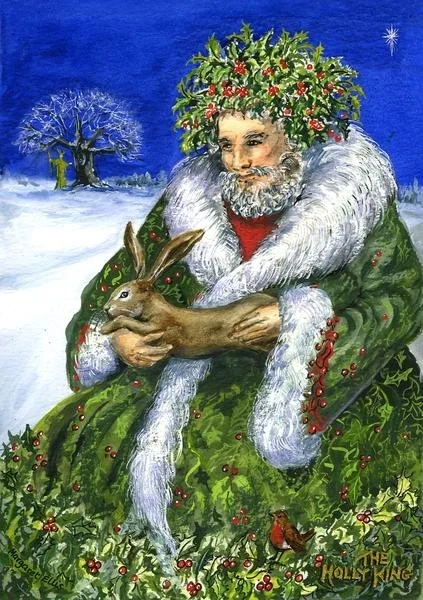
The pair are often seen as the dual aspects of a single male Earth deity, representing the waxing and waning halves of the year, summer and winter, and light and darkness. There are a number of paired mythological hero-figures that are put forth as variants of the Holly and Oak King myth, including Gawain and the Green Knight, Gwyn and Gwythr, and St. John the Baptist and Jesus [1].
The Holly King and the Oak King are described by Graves to be locked in an eternal struggle for the favor of the Goddess. The Holly King emerges on the summer solstice to slay his brother at the height of his power, only to have the same happen to him on the winter solstice.
Because there is no specific source myth, descriptions of the Holly King are interpretive and tend to vary. In one tradition he is described as an immortal giant wielding a large club of holly wood [3]. He is “the lord of darkness, death, animals and withering […] a horned god […] the avenger, older [than the Oak King], whose wild hunt runs free to protect and avenge” [4]. Others interpret the Holly King as more jovial, and potentially as an early precursor to Santa Claus [2]. Traditional British Christmas carol “The Holly and the Ivy” makes reference to the Holly King, saying:
Of all the trees that are in the wood
The holly wears the crown [1]
The story
Once upon a time, there was a kingdom ruled by two kings, who were also brothers. The younger wore a crown of oak leaves and was known as the Oak King. The older wore a crown of holly leaves and was called the Holly King.
Each brother was certain he knew how best to rule the kingdom, and so they argued constantly. The Oak King wanted a warm, bright, and sunny land year-round. The Holly King, on the other hand, wanted a cold, dark world that slept year-round.

Both brothers loved the same beautiful woman, and she loved both brothers. She hated to see them argue, so she suggested they exchange kingdoms: half the year for the Oak King and half the year for the Holly King.
Yet the bickering did not end. One day, when the sun was high in the sky and night seemed to never come, the Holly King brandished his sword at his brother and started a battle. King Oak fought bravely, but his efforts were in vain; a fatal blow from his brother sent him tumbling to the ground.
“My brother!” King Holly cried, holding King Oak’s bloody body in his arms. The woman they both loved wrapped King Oak’s body in her arms and told King Holly that he must now rule the kingdom. She then departed, carrying the dead king’s body with her.
Every day, the hours in which the sun shone grew shorter and shorter. Every night, the moon dominated the sky for longer and longer. The days grew shorter and cooler, the nights longer and colder. Snow began to fall. King Holly could think of nothing but his brother.
Finally, the earth was bare and all the plants were asleep. Many animals slept during this cold period, while many others did not and struggled to find food. One night, when the sun seemed never to rise, the woman went to the king and said, “Don’t despair, your brother is not dead. He is here to take his place in governing the kingdom.”
And there he was, King Oak, young and healthy again, and King Holly, happy, stepped aside, yielding the throne to his brother.
With the new king, the kingdom was reborn. The days grew longer and milder, the moon rode the sky for a shorter time. The earth turned green again, and the plants and animals awoke.
The circle continues: one brother rules the green period, the other the dark period.
This is how our Celtic ancestors explained the seasons.
The meaning
In Northern Europe, where the cold is truly cold, one of the world’s oldest battles takes place on this very day: the battle between darkness and light.
King Oak represents light, King Holly represents darkness.
But in reality, the two are not ordinary, flesh-and-blood kings: they are trees, the spirits of all holly and oak trees. King Holly is King Holly, King Oak is King Oak.
The battle, according to tradition, is fought today, as tradition and astronomy dictate, and Oak will win.
Because starting tomorrow, the days will begin to lengthen, and Oak will go to lick his wounds in a silent place until the end of June, when he will return to the fray.
Associations and Suggested Offerings
People with birthdays between the summer and winter solstice (zodiac signs Cancer, Leo, Virgo, Scorpio, and Sagittarius) may feel particularly influenced by the Holly King, having been born during his reign.
Suggested offerings to the Holly King include holly, wren feathers, antler velvet, chestnuts, and other traditional midwinter correspondences.
Best rituals to honor the Holly King
On the winter solstice, honor the Holly King with a few simple rituals
Fire
We women and men are guardians of fire, even if we’ve forgotten it: today is a good day to dust off this ancient role as guardians. If you don’t have the opportunity to light a fire, at least light a candle.
Don’t let your light go out. Reflect on the past year and throw into the fire exactly what you want to bring with it.
If it’s something materially substantial (like a refrigerator), draw it or write its name on a piece of paper and burn the paper. I won’t explain this highly symbolic gesture.
Another option is to tie your good intention to a seed. Expose the seed to the dampness of the night, let it awaken and prepare it for the earth.
Sow tomorrow morning. I will sow my beloved marigolds and some mallow seeds, handing them my hopes for the new year.
Prepare a dessert
Say hello to the year with something sweet so that the new year will be equally sweet. Gingerbread or Hildegard of Bingen’s Happiness Cookies are perfect.
Prepare your hot drink
And drink it with your family. Nothing better than an aromatic red wine made with orange, lemon, spices, and honey.
If you’re wondering what spices to use, here are the ones I commonly use after my travels in Germany: cinnamon, star anise, cloves, and a pinch of nutmeg. Heat the wine and your chosen ingredients; let it warm and serve.
And remember: don’t let your light go out, and don’t let your darkness go out. Find the right balance because the two are not enemies, but old, very old friends.
Conclusion
The holly king is a highly symbolic and meaningful deity.
Connecting with him gives you the opportunity to truly understand and embrace the winter solstice while opening yourself up to the wheel of the year, its transformative energy and becoming more aware of the energy of each season


 English
  Spanish